Summary:
Our project will model the black hole Sagittarius A*, with a primary focus on how light rays are realistically affected by the gravitational pull of a black hole. Our ray tracing model will incorporate gravity on each ray to model the black hole's Schwarzschild radius, as well as demonstrating how light reflects off of various objects, such as asteroids and spacecraft, as they approach the black hole. Overall, our project will aid in visualizing potential interactions in space that traditional ray tracing algorithms would struggle to accurately represent.
Teammates:
- Ryan Lee
- Phone Myat Min
- Jake Pastoria
- Ryan Trinh
Problem Description
The issue our project is trying to solve is that traditional ray tracing models assume that rays are unaffected by gravity. This assumption is valid in the majority of situations, but as the scale of the environment grows, as in the case with astronomical representations, this becomes further and further from the truth. Light rays that should be curving due to celestial bodies instead just continue moving in a straight line, culminating in a distorted image.
Solving this problem is important, as without it, physically accurate modeling of space wouldn't be possible. The human perception of distant celestial objects is solely based on these reflected light rays, so to understand how these objects truly look physically, a precise understanding of how light would travel through space is crucial.
However, this project isn't without many challenges. For one, the calculations required for each ray will be much more complicated compared to the ray tracing algorithms we've previously discussed. Not only does this mean there will be more complicated models involved, but the computational load to simulate the model will be much higher. To solve this type of issue, it'll be necessary to come up with more optimization strategies through tactics such as approximating ray paths rather than computing each one directly.
Goals and Deliverables
What do we plan to deliver?
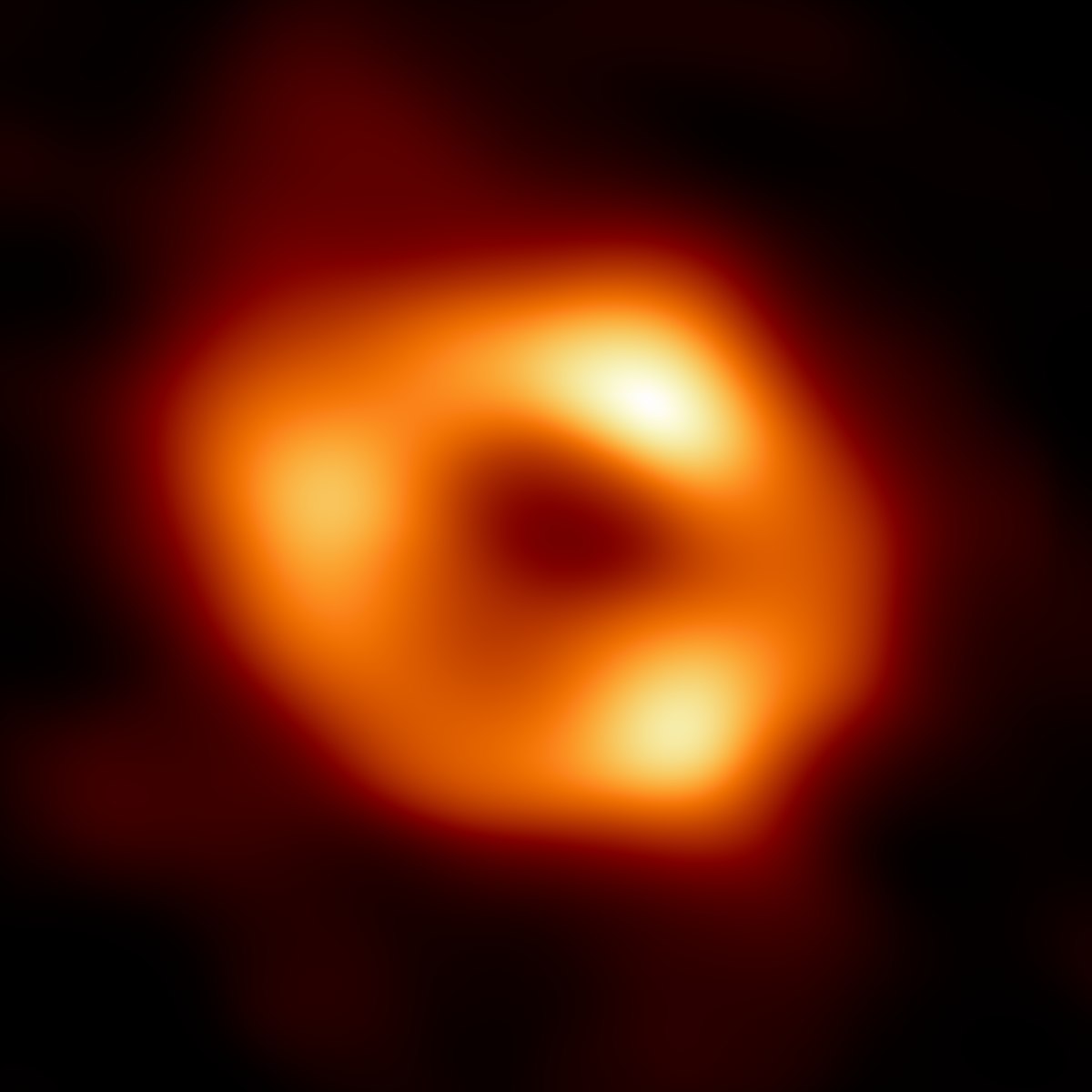
Our main deliverable is a render of ambient cosmic background light bending around the Schwarzschild radius of Sagittarius A*, as shown in the image below.
To produce this final render, we must approach the problem from two fronts: understanding the underlying physics
of general relativity and implementing computational methods to apply ray tracing for accurate modeling. The main
physical phenomena that we plan to emulate in our project are gravitational lensing, accretion disks, and the
Schwarzschild radius of black holes. These phenomena act as the core deliverables that will result in ray-tracing
that follows Einstein's theory of relativity.
In terms of measuring the "success" of our project, there are two main areas we are going to consider. The first is simply the generation of an image that
simulates the effect of a gravity around a blackhole. In order to do so, we will need to create a ray tracing algorithm that mimics the effect
of gravity on light. The second important aspect is establishing efficient ray tracing that can be rendered in a reasonable amount of time.
Our system will likely contain an immense number of calculations per ray to simulate real life, meaning we need optimize our code in addition to considering
the underlying physics.
What do we hope to deliver?
Once we have laid down the foundation of modelling Sagittarius A* through producing the phenomena mentioned above, we hope to also include a depiction of red shifting and the doppler effect. We'd demonstrate these effects by having some type of object (spacecraft or asteroid) approach the black hole, making renders at decreasing distances. The object should begin to redshift, and eventually, no light would escape, and thus the object would disappear.
Schedule
| Starting Date | Deadline | Task | Details |
|---|---|---|---|
| 7/28 | 8/3 | Milestone Deliverables |
|
| 8/4 | 8/10 | Final Deliverables |
|
| 8/11 | 8/12 | Final Presentation / Practicing |
|